
Verification
Anyone can claim it. You can prove it.
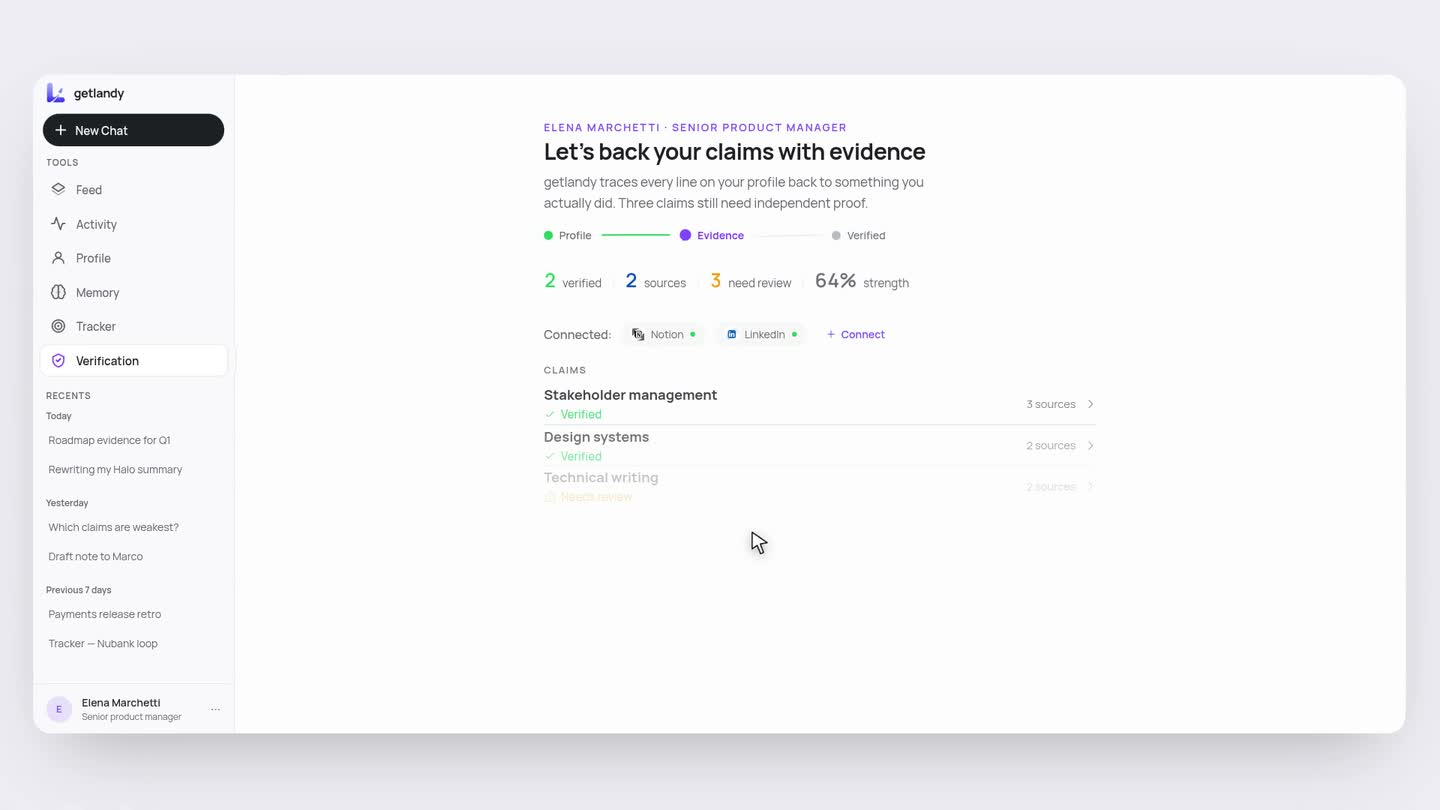
Skills are validated through evidence in your own work, peer review from people you have actually worked with, and documented credentials — then published as a profile a recruiter can trust.
What you can stop doing
A skills list nobody checks.
Endorsements from people who never worked with you.
Certificates sitting in a downloads folder.
Asking a stranger to take your word for it.
The problem
A claim and a proof look identical on a CV.
Every candidate lists the same skills, so the list stops carrying information. Readers fall back on brand names and referrals instead — the part of hiring that is hardest to break into and easiest to game.
- 01
Self-reported by default
Nothing on a standard profile has been checked by anyone. The reader knows that, and discounts all of it equally.
- 02
Endorsements are noise
One click from someone who has never seen your work counts the same as five years sitting beside you.
- 03
The evidence never travels
The proof exists — in the work, the reviews, the credentials — but it stays behind while the claim goes out alone.
What it does
Built around one record.
Evidence, then a score
Each skill is scored against what your record actually shows, so the number means something.
Peer review that counts
Colleagues confirm the work they saw first hand. Endorsements come from people, not from strangers clicking a button.
A profile worth sharing
Your public getlandy profile carries the verified record, at a link you can put in any application.
Credentials, checked
Qualifications are recorded with their issuer and date, so they can be looked up rather than believed.
Every score shows its working
Open any skill and see which projects, reviews and documents it was scored against.
It can go down
A claim nothing supports says so. A verification system that only ever flatters you is not verifying anything.
How it works
Four steps, start to finish.
Map
Skills are drawn from your record rather than typed in, so the list starts from what you actually did.
Evidence
Each one is matched against the projects, documents and outcomes in your record that support it.
Review
You invite people who saw the work. They confirm what they can speak to first hand, and only that.
Publish
The verified record becomes a getlandy profile, at a link you control and can revoke.
What you actually get
Verification is four working surfaces.
- 01
Verification
Skill-by-skill scoring against your own evidence.
- 02
Peer approval
Confirmation from people you actually worked with.
- 03
getlandy profile
The public, verified version of your record.
- 04
Credentials
Qualifications recorded with issuer and date.
Questions
Before you start.
People you have worked with, invited by you. They confirm only the work they saw first hand.
How well a claimed skill is supported by evidence in your record. Open any skill and you can see exactly what was counted.
You choose what your getlandy profile shows. What you cannot do is show a number the evidence does not support — a system that only ever agrees with you is worth nothing to the person reading it.
No. The profile is a link that opens for anyone you send it to.
Read more
How do AI agents verify work history?
AI agents can read a career record but cannot confirm it. Verification comes from attached evidence, peer confirmation and issued credentials — not from the model.
Read the answerWhat is a professional identity layer?
A professional identity layer is one structured, verified record of your working life that you own and that both people and AI agents can read.
Read the answer
Start with Verification.
One conversation is enough to begin. Everything after that reads from the same record.