
Opportunities
The search, run properly.
Every application, conversation and follow-up in one pipeline, with agents working in the background on the roles and the routes you have not found yet.
What you can stop doing
A spreadsheet you stopped updating in week two.
Job alerts matched on keywords you no longer use.
A follow-up you meant to send nine days ago.
Guessing which countries would even have you.
The problem
A search is a project, and most people run it without a system.
Applications, conversations, follow-ups and deadlines each live somewhere different, or in your head. What usually loses is not a weak candidate — it is a strong one who lost track.
- 01
No single view
Applications in an inbox, contacts in a phone, notes in a doc. Nothing tells you what needs you today.
- 02
Follow-ups get missed
The message that would have moved it forward was never sent, because nothing said it was due.
- 03
The search stops when you do
Nothing is looking on the days you are not, so a good role that opened in a bad week is simply never seen.
What it does
Built around one record.
Nothing falls through
Applications, contacts and next steps are tracked in one place, with follow-ups drafted when they are due.
Agents that keep looking
getlandy keeps scanning for roles that fit the record you have built, not the keywords you last typed.
Routes across borders
Relocation signals show which countries and visa routes your experience actually qualifies you for.
One board, every stage
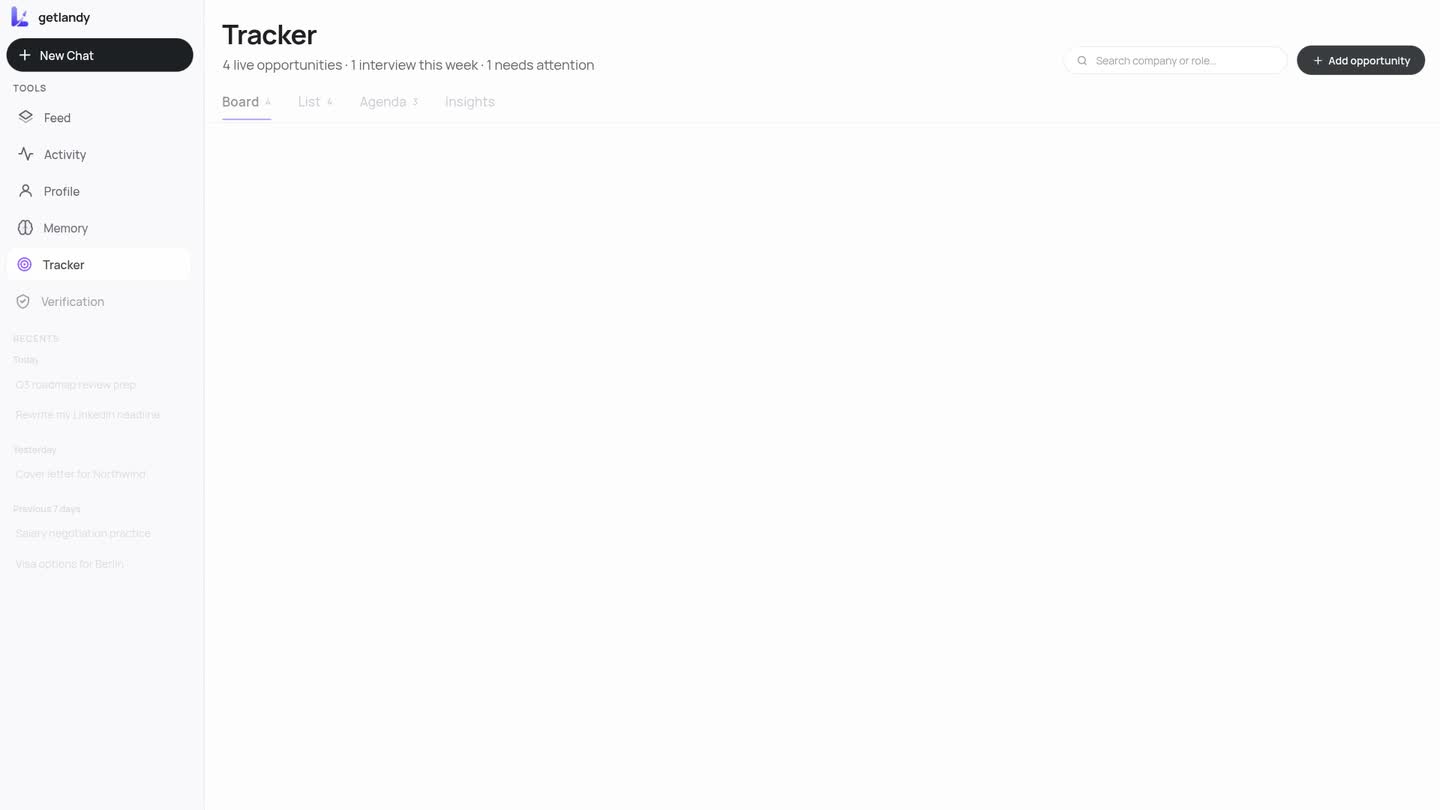
Applied, interviewing, offered, closed — the whole pipeline in one view, sorted by what needs you next.
The people, not just the roles
Contacts, conversations and where you left off, attached to the opportunity they belong to.
A strategist on call
Ask what to prioritise this week and get an answer grounded in your actual pipeline.
How it works
Four steps, start to finish.
Track
Every application logged with its stage, its contact and the next thing it needs.
Watch
Agents keep scanning for roles that fit the record you have built, on the days you are not looking.
Act
Follow-ups are drafted when they are due, from the context of that specific conversation.
Widen
When the local market is thin, relocation signals open the search to the countries your record already qualifies you for.
What you actually get
Opportunities is four working surfaces.
- 01
Pipeline
Every application and its stage, on one board.
- 02
Agents
Background search against your record, not your keywords.
- 03
Relocation
Visa routes matched to verified experience.
- 04
Strategist
Guidance grounded in your live pipeline.
Questions
Before you start.
Agents search against your record rather than a keyword string, so what surfaces is matched to evidence you actually have.
No. It drafts and it tracks. Sending is always yours.
A read of which countries and visa routes your verified experience qualifies you for, so you are not researching immigration policy from zero.
Yes. Add them to your Pipeline at their current stage, and follow-ups pick up from there.
Read more
How do AI agents verify work history?
AI agents can read a career record but cannot confirm it. Verification comes from attached evidence, peer confirmation and issued credentials — not from the model.
Read the answerWho owns your professional data?
Employers hold your record, platforms hold your profile, and export gives you a copy rather than control. Ownership means the working version is yours.
Read the answer
Start with Opportunities.
One conversation is enough to begin. Everything after that reads from the same record.