
Application
Stop starting from a blank page.
CVs, cover letters, LinkedIn posts and headshots are all generated from the same verified record — so they agree with each other, and with the truth.
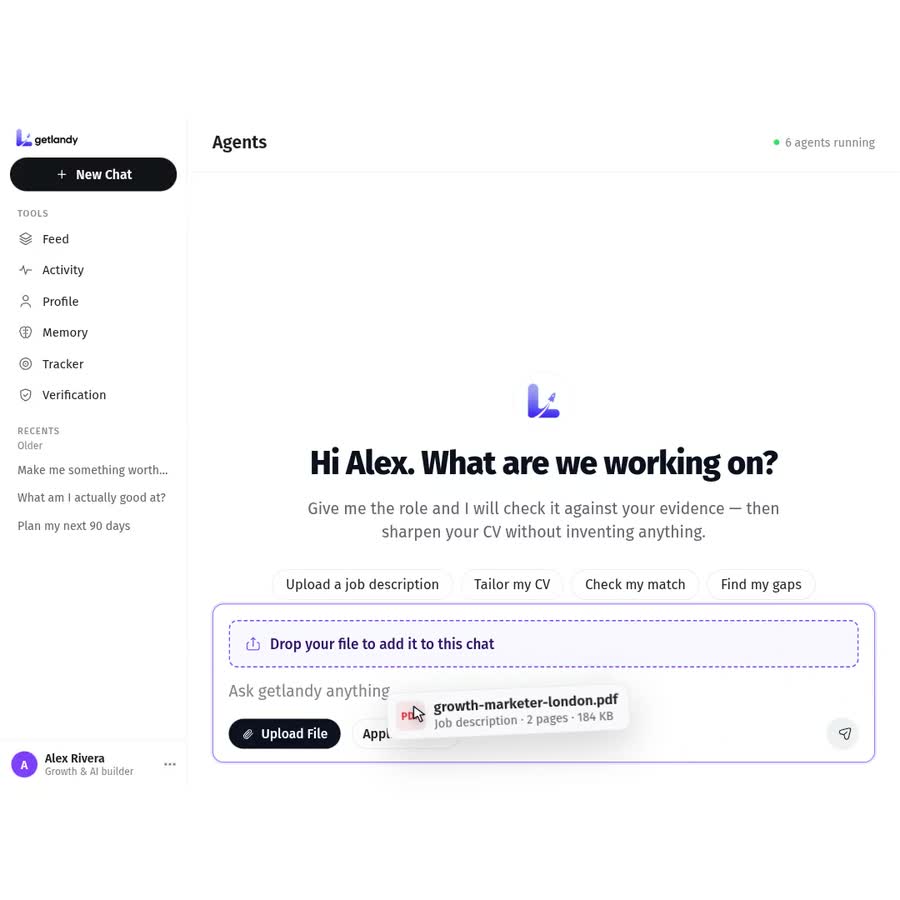
What you can stop doing
Twelve versions of a CV, all named final.
An evening spent rewording the same cover letter.
A headshot from four jobs ago.
Guessing which keywords the filter wants.
The problem
The writing is the bottleneck, and it is the same writing every time.
Every role wants the same facts arranged differently. Doing that by hand is slow enough that most people send something generic instead — and generic is the first thing both the filter and the reader discard.
- 01
Rebuilt from scratch
The facts have not changed since your last application. The document gets written from nothing anyway.
- 02
Drifts out of sync
The CV says one thing and the profile another, because whichever you edited last quietly won.
- 03
Reads like everyone else
A generic tool produces generic copy, which lands as effort you did not put in.
What it does
Built around one record.
Tailored per role
Paste a job description and the CV reorders itself around what that employer is actually asking for.
Written in your voice
getlandy learns how you write from your own material, so the output does not read like everyone else’s.
One record, every format
Change a fact once. The CV, the letter and the profile all move with it.
Built to be read twice
Structured so a filter can parse it and a person still wants to read it. Those are not the same requirement.
Nothing invented
Every line traces back to something in your record. The tool cannot claim what you have not done.
Headshots included
Photo Studio produces a current, consistent portrait for the profile and the application.
How it works
Four steps, start to finish.
Paste the role
The job description goes in, and getlandy reads what that employer is actually asking for.
Match
Your record is searched for the evidence that answers it, and ordered by relevance to this role.
Draft
CV, cover letter and post are written from that evidence, in your voice rather than a house style.
Approve
You read, edit and send. Nothing leaves without you.
What you actually get
Application is four working surfaces.
- 01
CV Studio
Role-tailored CVs, built from the verified record.
- 02
Cover Letter
Letters that reference the work, not the job title.
- 03
LinkedIn Studio
Posts and profile copy in your own voice.
- 04
Photo Studio
A current, consistent professional portrait.
Questions
Before you start.
No. Every line is written from your record, and your record only holds what you put in it.
Always. The draft is a starting point, and nothing sends itself.
A formatted document you can download, and the same content as plain text for the forms that want it pasted in.
That is where it helps most. The same record reorders around a different set of requirements without you rewriting your history.
Read more
Why do AI-written CVs get rejected?
AI-written CVs fail when the model has no real record to work from: fluent, generic text describing a plausible candidate rather than a real one.
Read the answerWhat is Professional DNA?
Professional DNA is the structured, evidence-backed record of your career that getlandy builds once and uses to generate everything you send.
Read the answer
Start with Application.
One conversation is enough to begin. Everything after that reads from the same record.